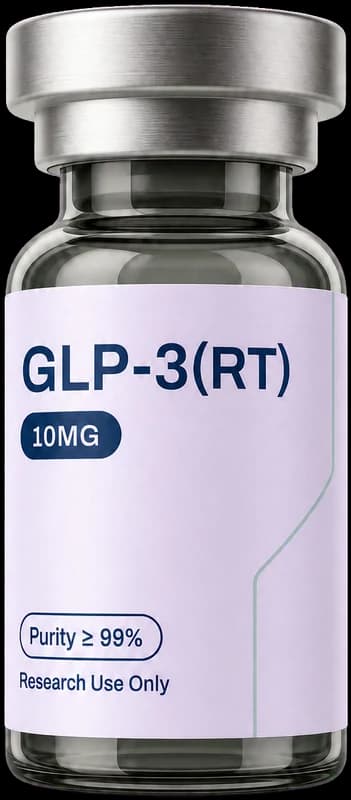
The GLP Explainer: What the Retatrutide-Class / GLP-1 & GLP-3 Conversation Actually Is
You've seen the letters everywhere — GLP-1, and now the shiny new "GLP-3" — thrown around like everyone already knows what they mean. Almost nobody explains it straight. In about 8 minutes, here's the calm, no-hype version: what GLP actually stands for, why "GLP-3" is not the sequel you think it is, and the one distinction that keeps you from getting played in the most hyped corner of this whole space.
By PepQuiz · Research-framed, not medical advice · Editorial standards
The 60-second version
1/7
"GLP-1/2/3" counts receptors a compound is studied to hit — not version numbers.
The full guide · 8 min
So what does 'GLP' actually stand for?
Let's slow all the way down and start with the least intimidating possible version, because nobody actually tells you what the letters mean before they start selling you on them.
GLP-1 stands for glucagon-like peptide-1. Say that at a party and you'll clear the room. So here's the plain-English version: it's a hormone your own body already makes, released in your gut after you eat. It belongs to a family scientists call incretins — the little signals that fire off around a meal and help your body coordinate its response to food. Insulin release, the feeling of fullness, the pace your stomach empties — GLP-1 is one of the messengers in that conversation.
Read that again, because it reframes everything that follows: GLP-1 isn't a chemical someone invented in a lab. It's a signal you're running right now, for free, without thinking about it. Your body has been making it your whole life.
So when you hear people talk about 'the GLP compounds,' what they mean is a class of compounds that have been studied in research for how they interact with those same incretin pathways. Not some alien substance bolted onto your system — lab-made stand-ins studied against a signal you already speak fluently. That's the honest starting point. Everything else is just detail on top of it.
GLP-1 isn't a chemical someone invented. It's a signal your body has been running your whole life — for free.
GLP-1, GLP-2, GLP-3 — wait, are there three of them?
Here's where the internet quietly confuses everyone. You'll see 'GLP-1,' then 'GLP-2,' then the shiny new 'GLP-3,' and it sure sounds like a lineup of sequels — each one a newer, stronger version of the last, like phone models. That is not what those numbers mean. Read this part slowly, because getting it right instantly makes you sharper than most of your feed.
Think of your body's metabolic signaling as a wall of locks. A compound studied in this space behaves like a key — it's investigated for how it fits certain locks (scientists call the locks receptors). The number people tag on is basically counting how many different locks a given compound is studied to fit:
- A single agonist is studied against one main pathway (the GLP-1 receptor). One key.
- A dual agonist is studied against two pathways at once (often GLP-1 plus another incretin called GIP). Two keys on the ring.
- A triple agonist — the retatrutide-class compound the 'GLP-3' nickname points at — is studied against three pathways (GLP-1, GIP, and glucagon). Three keys.
So 'GLP-3' isn't a third species of GLP-1, and it isn't 'GLP-1 but the 2026 model.' It's community shorthand for a compound studied to hit three receptors instead of one. The number counts targets, not upgrades.
And here's the part the hype-bros skip: more keys is not automatically 'more good.' More receptors touched means a broader, more complicated, more body-wide set of effects to study — which means more unknowns, not fewer. Big, blunt, body-wide reach cuts both ways. More targets, more to learn. Not less.
The number counts receptors, not upgrades. More targets means more unknowns — not automatically more benefit.
The prescription-medicine vs research-chemical fork — read this twice
This is the single most important distinction in the entire GLP conversation, and it's the one social media blurs the hardest. So here's the straight version, and you deserve it plainly.
Compounds that interact with these incretin pathways actually live in two completely different worlds — and people talk about them as if they're one thing. They are not.
World one: FDA-approved prescription medicines. Some compounds in this broad family have gone through large human trials and are approved, prescribed by a licensed clinician, and dispensed through a real pharmacy — with a known identity, a known amount, and medical supervision attached to them on purpose. That's the regulated lane. It has a doctor in it by design.
World two: gray-market 'research chemicals.' Then there are vials sold online, labeled 'for research use only,' that reference the same compound names. These are not FDA-approved products, not dispensed by a pharmacy, and not verified by anyone unless a batch-specific, third-party COA says so. Same words on the label. Completely different supply chain, oversight, and certainty about what's actually inside.
Here's why this matters more here than almost anywhere else in peptides: retatrutide — the compound the 'GLP-3' talk orbits — is investigational. It has been studied in human clinical trials, but it is not FDA-approved. So the gray-market versions aren't a cheaper copy of an approved product — they're an unapproved compound, sold outside the very system that would otherwise verify what it is.
Say it plainly:
- 'Studied in a clinical trial' is not 'approved for you to buy in a vial.'
- 'Same name on the label' is not 'same thing in the bottle.'
- An approved prescription and a research-chemical vial are not interchangeable — no matter how confidently a seller implies they are.
If you're going to look into this class at all, the approved-medicine, doctor-in-the-room lane exists — and a qualified healthcare professional is the person to ask about it. Not a caption.
'Same name on the label' is not 'same thing in the bottle.'
What the research actually looks at (and the 'in what?' reflex)
Okay — so what has this class actually been studied for? I'm going to word this carefully, because the wording is the whole point.
- Retatrutide-class (the 'GLP-3' triple agonist) compounds are studied in research in the context of activity across multiple metabolic receptor pathways.
- AOD-9604 (a fragment of the growth-hormone molecule) has been researched in the context of metabolic and fat-metabolism pathways.
- MOTS-c (a mitochondrial-derived peptide) is studied in the context of metabolic signaling.
Notice what those sentences do and don't say. They describe what researchers investigated — not a promise about your body.
That's the discipline this whole class demands, and there's one question that does the heavy lifting for you. Every single time you hear a claim, ask: 'in what?'
- Studied in a cell or a dish? Earliest possible signal.
- Studied in animals? A direction with big caveats — a result in a mouse is a hypothesis about humans, not a fact about them.
- Studied in a small human trial? More real, still early.
- Studied in large, repeated human trials? Now there's a real conversation.
The retatrutide-class compounds are genuinely interesting, and among the most-studied of the newer metabolic research compounds — AND they are recent, AND the long-term human picture is still being filled in. Hold all three at once. 'Fascinating' and 'early' and 'people online swear by it' can all be true in the same breath, and not one of them is the same word as 'settled.'
One more honest note, because it's the exact place people fool themselves here: 'your body already makes GLP-1' is a true sentence, and it is not a safety argument. 'Natural' and 'endogenous' don't mean 'harmless,' and a signal your body doses precisely on its own is a very different thing from a compound studied at research levels. Curiosity is great. Magic thinking is not.
'Your body already makes it' is a true sentence. It is not a safety argument.
Why this lane attracts the most hype — and the most scams
Now the part a guy with a ring light and something to sell will never volunteer.
This is the busiest search bucket in the entire peptide world right now. And wherever the crowd is biggest, two things follow like clockwork: the loudest hype and the sketchiest sourcing. When millions of people are typing the same compound into a search bar, there is enormous money in selling them a vial — and not much stopping someone from selling them the wrong one.
So here's what to expect, and what to refuse:
- Outcome and cure claims. Any seller promising a product will treat, cure, melt, or fix something is both lying and breaking the rules everyone more careful actually follows. Legitimate sources talk about what's been documented in research — not miracles.
- Testimonials dressed up as evidence. A dramatic before/after clip is content, not data. The comment section is entertainment, not a study.
- 'It's basically the same as the prescription' energy. We just covered why that's not true. A seller blurring the approved-medicine and research-chemical lanes is telling you something important about themselves.
- No COA, or a generic one. In a lane this hyped, a batch-specific, third-party certificate of analysis isn't a nicety — it's the floor. Match the batch or assume nothing.
And here's the one we will never do, on purpose: give you doses, protocols, or 'here's what to run.' Not because we're being coy — because dosing this class is a real medical conversation for you and a professional who knows your history, not a blog. If a source is confidently handing specific numbers to strangers on the internet, treat that as a reason to trust it less, not more.
If a source hands out doses to strangers, that's a reason to trust it less — not more.
How to actually use this (the honest close)
So where does all this leave you? Honestly, in a genuinely good spot — because you now understand the thing most people loudly arguing about it don't.
Let's put the whole map on one card:
- GLP-1 is a signal your body already makes around meals.
- 'GLP-1 / GLP-2 / GLP-3' is shorthand for how many receptor pathways a compound is studied to hit — one, two, or three — not a version number, and not 'more equals better.'
- The retatrutide-class 'GLP-3' compound is investigational — studied in human trials, not FDA-approved, and sold in the gray market as a research chemical that's a different animal from the approved prescription lane.
- Everything worth knowing rides on one question: studied in what, and who's telling me?
Here's the honest limit of any article, though: this is written for the average curious person, and you're not average. Your real situation — your health history, your goals, whether the approved-medicine lane is even the right conversation for you — is exactly the stuff an article can't and shouldn't decide. That belongs to a qualified healthcare professional who actually knows you. Curiosity: encouraged. Reckless self-experimentation: hard pass.
If you want to turn this general map into your shortlist, that's the whole reason the quiz exists — a few questions, free, no email tricks or fake countdowns. The metabolic lane lands on our Fat Loss stack as a starting point for your research and that professional conversation — not the last word on anything.
One straight disclosure while money's on the table: some links here — including the Fat Loss stack, its partner store Prism Labs, and any COAs we point to — are affiliate links, so pepquiz.co may earn a commission if you use them, at no extra cost to you. That never changes the standard we hold sources to, and none of this is a recommendation to buy or use any compound. These aren't FDA-approved for the uses people discuss — and the professional in the room always outranks the map.
You now understand the thing most people loudly arguing about it don't. The professional in the room always outranks the map.