BPC-157, Honestly: Why One Peptide Shows Up in Every Goal
If you've spent any time reading about peptides, you've noticed one name that will not leave you alone. Recovery? It's there. Skin? There. Gut? Especially there. BPC-157 shows up in almost every goal — and that quiet little "wait, is this stuff magic?" feeling is exactly what the hype-sellers are counting on. In about 15 minutes, here's the calm, no-hype version: what BPC-157 actually is, why it keeps reappearing, and how to hold all of it honestly.
By PepQuiz · Research-framed, not medical advice · Editorial standards
The 60-second version
1/7
One compound shows up everywhere because of how it's studied — not because it's magic.
The full guide · 8 min
So why does this one peptide keep following you around?
Let's name the thing you've already noticed, because it's real.
Open any peptide conversation and BPC-157 is somehow already in the room. The recovery crowd brings it up. The skin people mention it. The gut folks practically build a shrine to it. When a single compound shows up under every goal, your brain tends to jump one of two ways — "wow, a cure-all!" or "okay, that smells like marketing."
The honest answer is neither. BPC-157 keeps reappearing because of where and how it's been studied — not because it's a magic wand. A compound can be researched in a lot of different contexts and still be early, still be unproven in humans, still be a research chemical you shouldn't romanticize.
Think of it like a name that keeps turning up across a lot of different books in a library. That doesn't make the name true, or safe, or right for you. It makes it well-catalogued. Breadth of study and strength of evidence are two completely different things — and hype-sellers are betting you'll blur them together.
So we're going to do the un-fun, genuinely useful thing: separate "shows up a lot" from "proven a lot." By the end you'll understand exactly why this one peptide is everywhere — and, more importantly, you'll be immune to the person using that ubiquity to sell you something.
One peptide, many mentions. That's a starting question, not an answer.
Breadth of study and strength of evidence are two very different things. Hype-sellers bet you'll blur them together.
What 'BPC' actually stands for (and what it doesn't promise)
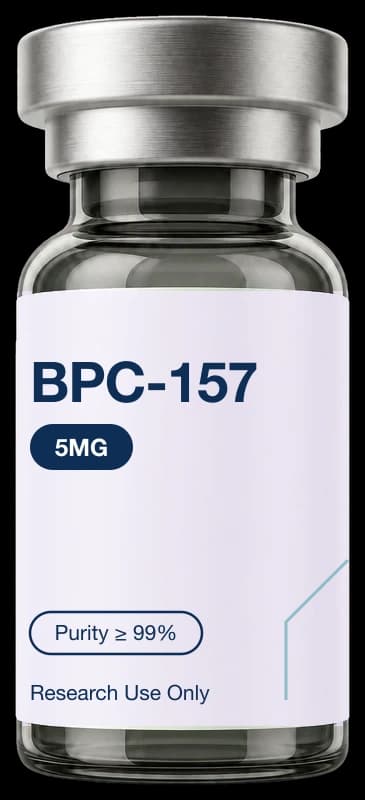
Here's a fact that instantly makes you sound like you did the reading: BPC-157 stands for "Body Protection Compound-157." And that name quietly explains most of why it's everywhere.
BPC-157 is a synthetic peptide chain — a short sequence of amino acids — related to a protein originally identified in gastric juice (yes, stomach fluid). Researchers found a protective protein there, isolated a specific fragment, and that fragment is what the research world calls BPC-157. It doesn't float around your body in this exact isolated form; it's a stable, lab-made sequence based on something biological.
That origin story matters for two reasons.
First, the "body protection" name is a description of the research interest, not a promise to you. It reflects the direction scientists went looking — tissue and connective-tissue repair processes, and gut-related processes especially — not a guaranteed effect in an actual human being. A research nickname is not a label of proven benefit.
Second, this is exactly where people get sloppy. "It comes from something the body makes, so it must be gentle" is the trap. "Natural" and "your body makes something related" do not mean "harmless." A stable synthetic fragment sold as a research chemical is its own thing, with its own unknowns, no matter how friendly its biological cousin sounds.
So the name is a great memory hook and a terrible safety argument. Hold it as trivia, not reassurance.
"Body Protection Compound" describes what researchers went looking for — not what's promised to you.
The gut is the center of gravity — here's the payoff
Remember the curiosity gap from the goal map — the promise that BPC-157 keeps showing up for a reason? Here's the payoff.
Much of BPC-157's research literature centers on the gut. It's sometimes called a "gastric" peptide precisely because of that stomach-fluid origin story, and a large share of the studies published on it sit in gut- and digestive-related contexts. When people say it's "everywhere," the gut is arguably the center of gravity that everything else orbits.
From that gut-centered core, the research fans outward into a few adjacent areas:
- Tissue and connective-tissue repair processes — the "recovery" lane, where it's usually discussed next to TB-500.
- The repair-signaling foundation that the skin-forward crowd layers under GHK-Cu in a "glow" context.
- Gut and broader inflammatory-signaling contexts — arguably where its research is most concentrated of all.
See what happened? One compound, studied across several overlapping repair-and-protection contexts, ends up name-dropped in three or four different goal buckets. That's not a cure-all. That's a compound with a broad research footprint — a lot of different studies asking a lot of different questions.
Here's the discipline that keeps you honest: "documented in the context of the gut" is a statement about what was studied, not about what will happen in your body. A broad literature tells you scientists were curious in many directions. It does not tell you any of those directions ended in proven, human-ready answers.
BPC-157 kept reappearing because the gut is where its research runs deepest — and everything else branches off that trunk.
The gut is the trunk; recovery and skin are branches. One tree, many mentions — not one miracle.
'Studied in research' — and mostly, honestly, in rats
Now the part the ring-light crowd speeds past.
The overwhelming majority of the exciting BPC-157 findings you've heard about come from research models — cells in a dish and animals, mostly rodents. Not large, repeated human trials. This is genuinely valuable early science, and it is genuinely early. Both are true at once.
So build the reflex: every time you hear a BPC-157 claim, ask "in what?"
- Studied in a cell culture? Earliest possible signal.
- Studied in rats or mice? Early direction, big caveats.
- Studied in humans, small trial? More real, still early.
- Studied in humans, large repeated trials? Now there's something solid — and for BPC-157, that tier is thin.
A result in a rat is a hypothesis about humans, not a fact about them. History is full of compounds that dazzled in rodents and did little, or something unexpected, in people. The gap between "documented in an animal model" and "proven in humans" is exactly where BPC-157 hype lives — because the animal research really is interesting, and "interesting in rats" is very easy to quietly upgrade into "works for you" in a caption.
Hold all three at once: the research is fascinating, AND it is early and largely preclinical, AND "people online swear by it" is not evidence. Internet testimonials are content, not data. A dramatic before-and-after clip is a piece of media, not a clinical outcome.
None of this means "ignore BPC-157." It means read it at the correct volume.
A result in a rat is a hypothesis about humans, not a fact about them.
Body-wide sounds amazing — read this part twice
Here's the claim you'll see most, and the one that deserves the most care, so read this part twice.
BPC-157 is often described as having systemic or "body-wide" research interest — the idea that a protective-signaling compound might be studied across many tissues rather than just one spot. On the surface that sounds like the best possible feature. More reach, more upside, right?
Flip it over. The exact thing that makes "body-wide" sound exciting is the thing that makes it deserve more caution, not less. A compound studied for broad signaling is, by definition, not a narrow, well-fenced tool — and the human safety picture for that kind of broad activity is one of the least-filled-in parts of the whole BPC-157 story. Long-term human data is sparse. Interaction data is sparse. "What does sustained use do in an actual person over years" is largely an open question, not a settled one.
That's not fear-mongering. It's the honest shape of the map: exciting breadth on one side, thin human safety data on the other. A grown-up holds both without flinching.
And this is precisely why the answer to "so how much should I take, and how" is not in this article — on purpose. Broad, systemic, early-stage research compounds are the last thing anyone should be freelancing with off a blog. That's a conversation for a qualified healthcare professional who knows your full history — not a caption, and not us.
"Body-wide" is a reason to slow down, not speed up.
The very thing that makes "body-wide" sound exciting is what makes it deserve more caution, not less.
How to actually hold this one in your head
So where does all this leave you? In a genuinely good spot — sharper than most people who've ever typed "BPC-157" into a search bar.
Here's the whole thing, honestly, in one breath: BPC-157 shows up in almost every goal because its research footprint is broad — tissue and connective-tissue repair, the skin-repair foundation, and especially the gut — not because it's a proven cure-all. Most of that research is early and preclinical. Much of the human safety picture isn't filled in. And it's sold as a research chemical, not an FDA-approved product for the uses people discuss online. Hold every one of those at once and you cannot be sold a fairy tale.
What we're deliberately not doing here is telling you doses, protocols, or "here's what to run." That's not us being coy — it's the whole point. Amounts, timing, formats, and whether any of this belongs anywhere near your body is a medical conversation for you and a licensed clinician who knows your history. A source handing specific numbers to strangers online is a reason to trust it less, not more.
What we can do is give you the map. If your goal is recovery, skin, or especially the gut, BPC-157 is one of the compounds worth actually understanding — and our Gut & Inflammation stack is where its research runs deepest. The quiz (5–8 questions, free, no email tricks) takes your specific goal blend and turns this general map into your shortlist. Then take that shortlist to a professional.
Curiosity: encouraged. Reckless self-experimentation: hard pass.
(Full disclosure: pepquiz.co may earn an affiliate commission if you buy through our Prism Labs link, at no extra cost to you. It never changes the standard we hold sources to — or a single word of what you just read.)
Broad research footprint, early evidence, real unknowns — hold all three and you can't be sold a fairy tale.